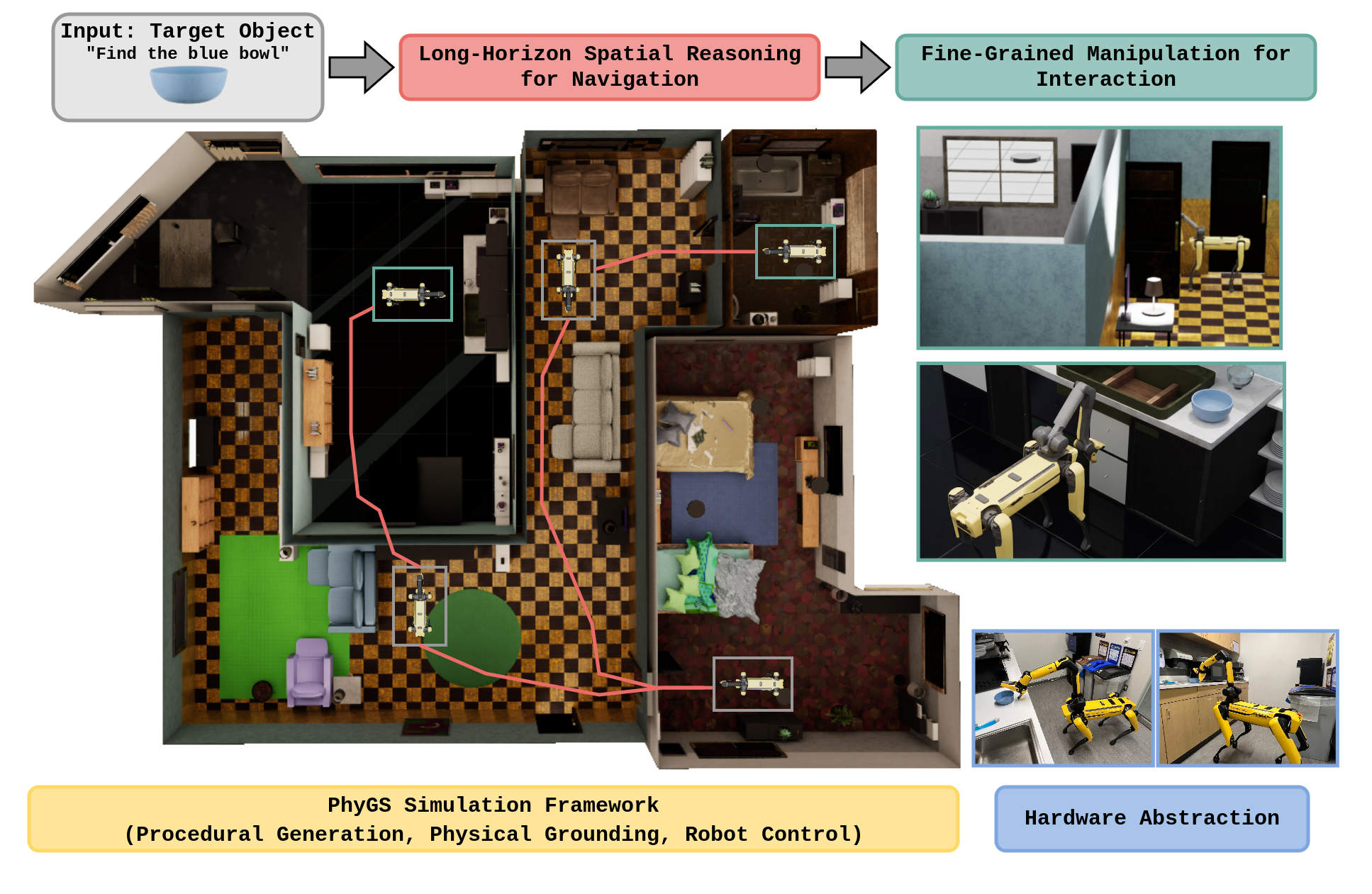
A robot must locate and retrieve a language-specified target in an unseen, house-scale home — often having to physically interact with the scene to make an occluded target perceivable.
1University of Michigan, Ann Arbor
A robot must locate and retrieve a language-specified target in an unseen, house-scale home — often having to physically interact with the scene to make an occluded target perceivable.
Interactive semantic object search is the task of locating and retrieving a target object in an unseen, house-scale environment. This task requires both long-horizon spatial reasoning for navigation and fine-grained skills for manipulation, often demanding that an agent physically interact with the environment to make an occluded target perceivable. Prior benchmarks have largely isolated one capability or the other; we present ForageBench, a benchmark designed to study them jointly on a mobile manipulator developed in our newly introduced simulation framework PhyGS.
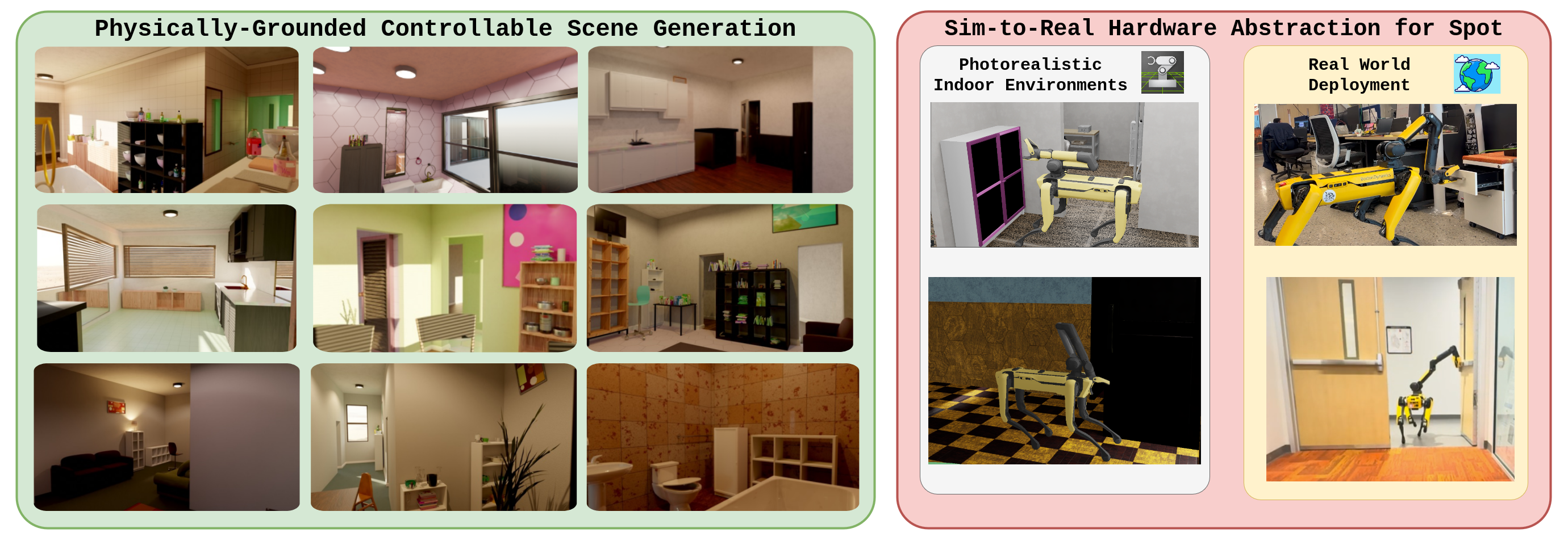
PhyGS integrates large-scale procedural scene generation with photorealism, physical grounding, and low-level robotic control. Using PhyGS, we build an evaluation dataset of 25 house-scale scenes and 100 episodes spanning a progression of difficulty, and benchmark state-of-the-art vision–language models acting as high-level skill orchestrators. Our best baseline on a simulated Boston Dynamics Spot with Arm achieves an interactive search success of only 4%. PhyGS provides a hardware-abstracted interface mirroring Spot's SDK for development transfer between simulation and the physical robot.
An agent starts at a collision-free pose in an unseen home, with no prior map, and is given a natural-language description of a target (e.g. "a ceramic mug"). It must perceive, physically retrieve, and report the target — perceiving through onboard RGB-D and acting through the robot's low-level controllers. Each scene contributes four episodes along a progression of difficulty:
25 procedurally generated single-story homes (two-, three-, and four-bedroom layouts, each with a bathroom, kitchen, living room, and dining room), populated with 50–200 unique gripper-scale objects from Objaverse-XL and articulated furniture — doors, cabinets, drawers, windows, ovens, dishwashers — set closed at episode start. All scenes are generated with PhyGS.
A high-level skill API matched to Spot's SDK. Methods may instead use the exposed continuous control directly.
navigate(target)
open_door(ref)
close_door(ref)
open_drawer(ref)
close_drawer(ref)
place(receptacle_ref)
report_found(object)
On the physical Spot (2x speed)
Gemini Robotics ER-1.6 driving a Boston Dynamics Spot with Arm in a two-bedroom household. We ran three sample experiments spanning the benchmark's easiest tier (separate room, perceivable) and its second-hardest tier (separate room, not perceivable); the agent knew the target's location in every episode. The white-pillow task was run twice — once with the door latched closed, and again with it left open.
We benchmark two vision–language models as high-level orchestrators over the skill library, under a known and an unknown target-location condition (each over all 100 episodes). Best per column in bold.
| Orchestrator | Known target location | Unknown target location | ||||||
|---|---|---|---|---|---|---|---|---|
| TS | IOSS | SPL | SPL-M | TS | IOSS | SPL | SPL-M | |
| Qwen3-VL-8B | 13.0 | 8.0 | 5.22 | 3.47 | 2.0 | 2.0 | 0.39 | 0.11 |
| Gemini Robotics ER-1.6 | 15.0 | 11.0 | 6.08 | 4.64 | 7.0 | 4.0 | 0.55 | 0.35 |
All values are percentages. Higher is better.
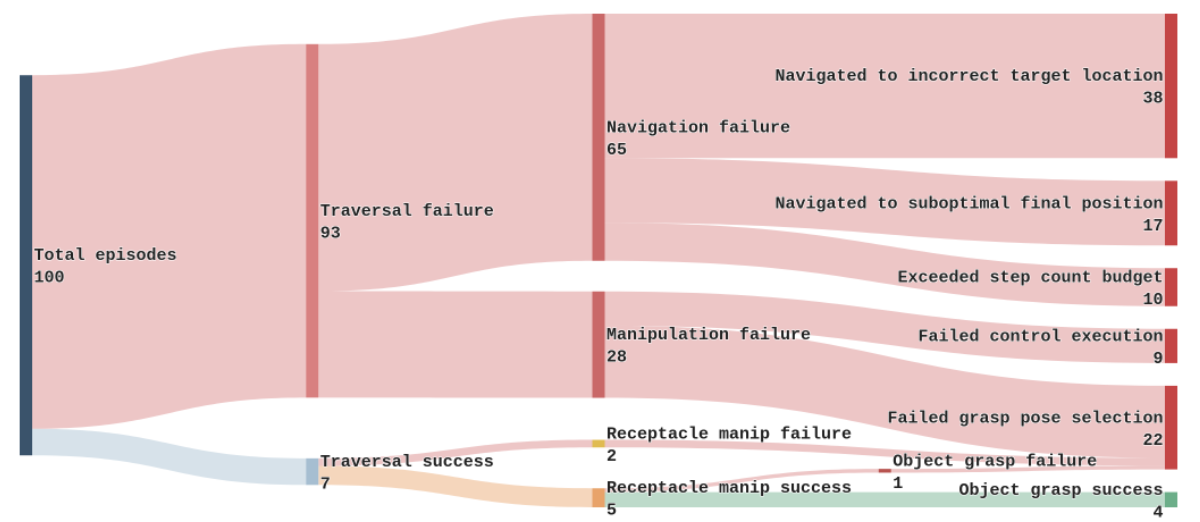
Interactive object search is far from solved. Even given the ground-truth target location, the best agent completes only 11% of episodes; with an unknown location this falls to 4%. Traversal is the dominant bottleneck — 93 of 100 episodes fail before the final manipulation stage — and path-length-weighted scores fall below 1%, showing that successful episodes are reached via highly inefficient trajectories.
The breakdown below traces where the 100 episodes fail. Only 7 reach the target's location; of these, manipulation succeeds in just 4. Within the 93 traversal failures, navigation errors dominate — the agent reaches the wrong location (38) or a suboptimal final pose (17) — while a smaller share exhaust the step budget (10) or hit low-level control errors. See the paper for the full per-tier analysis.
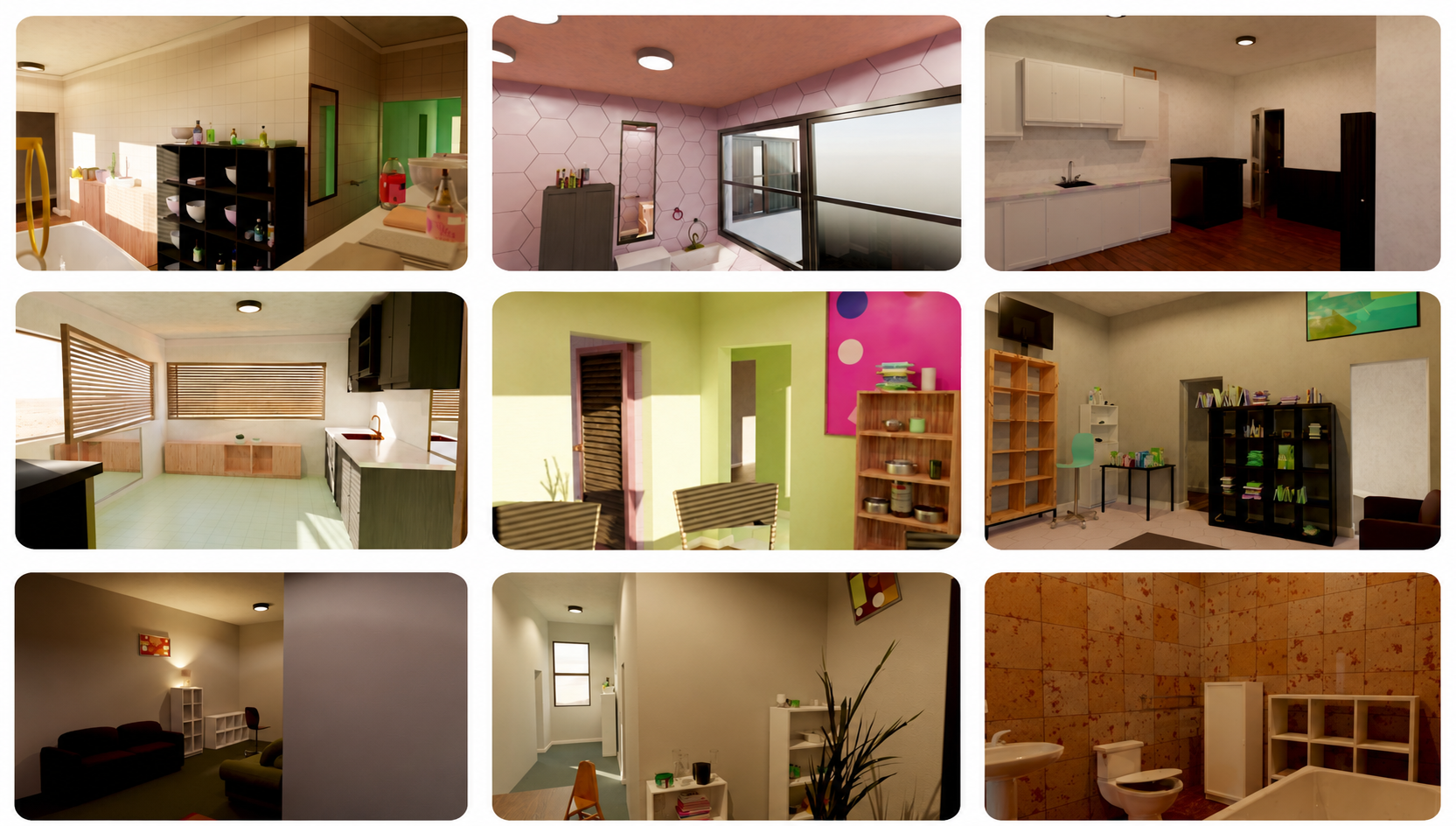
Every ForageBench scene is generated by PhyGS, our framework for photorealistic, physically grounded controllable scene generation in IsaacSim. The PhyGS code is available in beta.
@misc{saha2026foragebench,
  title  = {ForageBench: A Photorealistic, Physically Grounded
            Benchmark for Interactive Object Search},
  author = {Saha, Aparajito and Gan, Zhen Hao and Guo, Jinjia and
            Skwirsk, Jacob and Acheampong, Jeremy and Arapin, Anton and
            Ku, Chahyon and Hu, Yue and Fazeli, Nima and Bucher, Bernadette},
  year   = {2026}
}